

I want to write the review I wish someone had written for me before I bought the Cuisinart 7-Cup Pro Classic Food Processor. Not the one that tells you it changed how you cook, because it didn't, and not the one that lists every feature off the box like that settles anything. I've owned this Cuisinart for six months now, in a galley kitchen with twenty-two inches of usable counter beside the sink, and there are nights I reach for it without thinking twice and nights I look at it sitting up on top of the fridge and grab a knife instead. Both of those things are true, and a review that only tells you one of them isn't being honest with you.
This isn't a takedown. I still own the Cuisinart, I still use it several nights a week, and I'd probably buy it again. But "probably buy it again" and "it's perfect" are two different sentences, and most reviews collapse them into one. This one won't.
The Quick Verdict
Genuinely strong on volume chopping, but the setup and teardown cost is real, and it loses to a plain knife on small jobs more often than any glowing review admits.
Amazon Check Today's Price →Before you read the honest version, see what it actually costs today
The Cuisinart 7-Cup Pro Classic is a genuinely good machine with real limits, which is exactly what this review is about. Check today's price on Amazon so you have it in front of you while you read.
Amazon Check Today's Price on Amazon →The Setup Tax Nobody Puts in a Five-Star Review
Here's what actually happens on a Tuesday. The Cuisinart base lives on top of my fridge because there's nowhere else for it in a duplex kitchen this size, and getting it down is a two-hand job, not something I can do one-handed while stirring a pot with the other. The bowl, lid, blade, and the two discs live in a bin in my hall closet. So before I chop a single onion, I've climbed on a step stool, hauled a heavy base off the fridge, dug through a closet bin for parts, and assembled everything on the twenty-two inches of counter beside my sink. That's not a complaint about the Cuisinart specifically, most food processors this size ask the same of you, but it's the part that gets left out of nearly every glowing review I read before I bought mine.
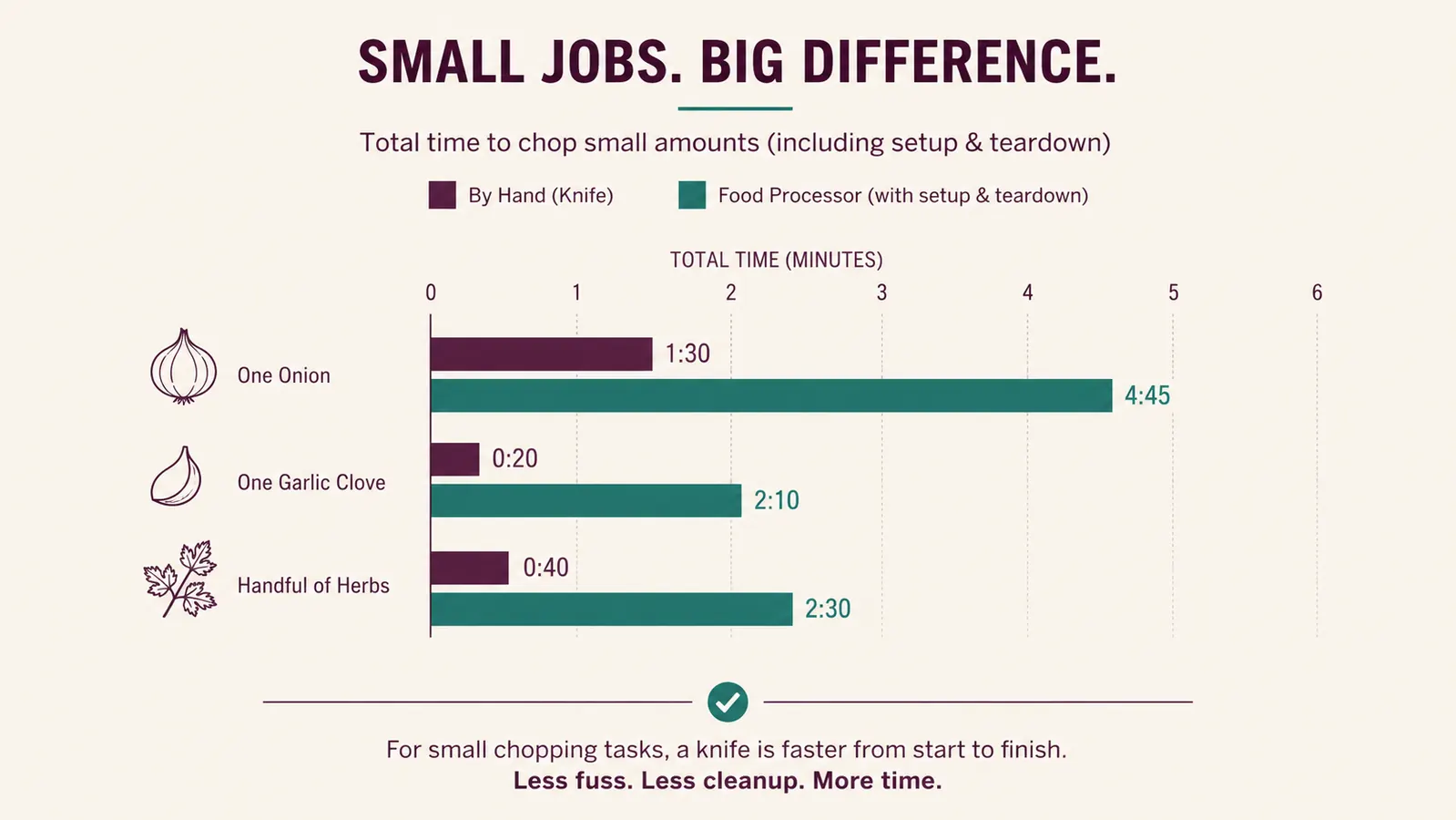
On a night when dinner is simple, two chicken breasts and a salad, that setup tax is real money against a fifteen-minute meal. I've genuinely stood in my kitchen doing math: is chopping this onion by hand faster than the four minutes it'll take to get the Cuisinart down, assembled, and running? More nights than I expected, the honest answer is yes, the knife wins. That's not a knock on the machine's performance, it's a knock on the gap between how food processors get marketed and how small kitchens actually work.
What tips the math back in the Cuisinart's favor is volume, not speed on a single task. One onion, grab a knife. A full weeknight's worth of prep, onions, carrots, celery, plus shredding a block of cheese, that's when the setup cost gets absorbed across enough chopping that it's worth it. The mistake I made in my first month was pulling the Cuisinart out for jobs a knife would have finished before the base even made it down off the fridge.
When a Knife Genuinely Beats the Cuisinart
I'll say the part most reviews won't. For small jobs, one shallot, a single clove of garlic, a handful of parsley, my knife wins every single time. Not because the Cuisinart can't do it, but because by the time I've hauled the base down and dug the bowl out of the closet bin, I could have had the shallot diced and be moving on to the next thing. A food processor's advantage is volume and consistency across a big batch, not speed on a job that takes ninety seconds with a blade you already have in your hand.
The same is true for anything where texture matters more than uniformity. Diced tomatoes for a salad where I want some pieces bigger than others, herbs I want roughly torn instead of pureed into a paste, the Cuisinart flattens all of that into one texture per pulse setting. It's very good at that one texture. It just isn't the tool for a dish that wants variation. I keep my knives sharp and my cutting board out for exactly this reason, and I'd guess most owners who are honest with themselves do the same, even if they don't put it in their five-star review.
What the 7-Cup Bowl Actually Holds, and What It Doesn't
Seven cups sounds like a lot until you're standing in front of it with a full recipe's worth of vegetables. It handles a whole head of cabbage for slaw, or two blocks of cheddar for a casserole, in one pass. That's genuinely useful and it's the size that convinced me to skip the 11-cup model in the first place, since a bigger bowl in a kitchen this size just means a bigger everything to store and wash.
But seven cups is not a family-of-five bowl, and it's not a batch-cooking bowl either. When I tried to prep a double batch of soup vegetables for the freezer, I hit the fill line with the onions alone and had to run the carrots and celery as a second load. That means washing the bowl mid-project or dirtying a second container to hold the finished onions while the carrots run, and either way the "it does it all at once" promise falls apart the moment your recipe scales past what two people eat for dinner. If you're cooking for a bigger household or you batch-cook on weekends, budget for at least one reload on anything beyond a simple weeknight meal, and don't expect the 7-cup Cuisinart to be a one-pass machine for a big pot of chili.
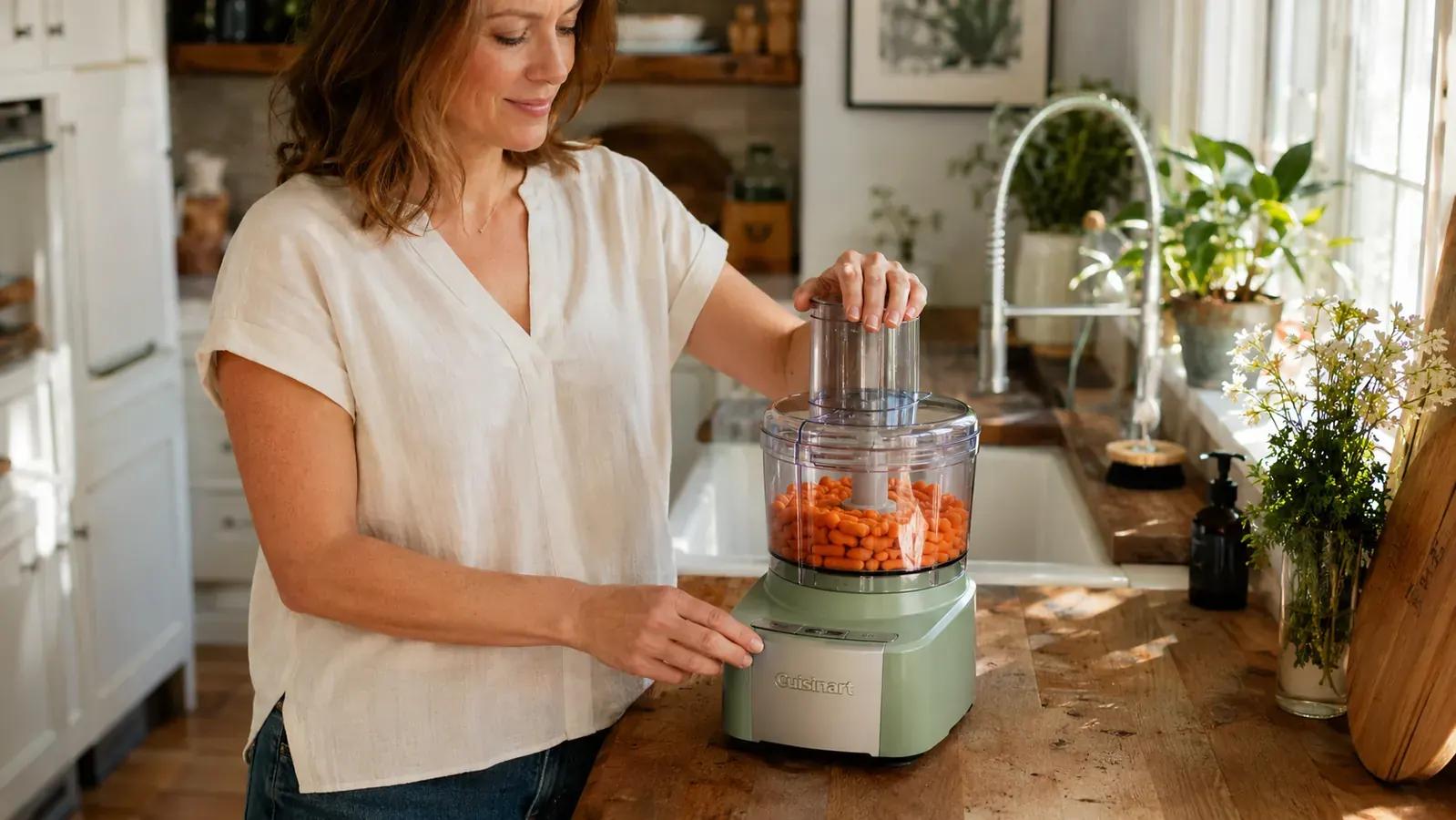
I also learned the bowl's real ceiling isn't the fill line, it's the blade's ability to move what's above the fill line. Pack it right up to the top with something dense like raw carrots and the blade struggles to pull everything down into the cutting path evenly, so the bottom layer turns to mush while the top barely gets touched. I now stop filling well before the marked line on anything dense, which effectively shrinks my working capacity to closer to five cups for the jobs that matter most.
The Parts-Count Problem in a Small Kitchen
Nobody mentions how many separate pieces you're actually responsible for until you own one. The Cuisinart bowl, the lid, the blade, the disc stem, the shredding disc, the slicing disc, and the base. That's seven parts for a single machine, and in a kitchen with a hall closet bin instead of a dedicated drawer, every one of them is a small decision about where it lives and whether it's clean when I need it. Compare that to a knife and a cutting board, two objects, always in the same place, always ready. The Cuisinart's part count is the real cost of what it does well, and it's a cost that compounds in a kitchen this size in a way it wouldn't in a house with a full pantry and dedicated cabinet space.
The plastic case that holds the two discs is the weakest link in that chain. Its hinge has loosened over six months of regular use, enough that I now keep a rubber band around it because I don't fully trust the latch to hold shut in the closet bin anymore. It still works, but it's exactly the kind of small failure that a first-week review would never catch, and it adds one more thing I have to think about every time I reach for that bin.
The narrow feed tube is a similar story. Whole cucumbers and zucchini won't drop through it, so I'm halving them lengthwise before the slicing disc can do its job, which adds a step and a second cutting board to the process every time. Ten extra seconds doesn't sound like much until you've done it fifty times, and by six months in it had started to feel like a design decision nobody warned me about before I bought the machine. If you want the play-by-play on how I actually work around it task by task, I wrote up how I prep vegetables with the Cuisinart food processor in more detail, including which cuts I stopped bothering with the disc for entirely.
Tough Ingredients: Where the 600 Watts Shows and Where It Doesn't
The Cuisinart's 600-watt motor is genuinely strong for its class, and on most weeknight jobs, onions, carrots, celery, soft cheese, cooked beans for hummus, it never hesitates. That part of the marketing holds up. Where it starts to strain is cold, dense ingredients straight out of the refrigerator. A wedge of parmesan cold from the fridge takes noticeably longer and sounds strained in a way a room-temperature block never does. It gets there, but I've learned to let hard cheese sit out for ten minutes before I run it through, which is a workaround I had to figure out myself because no spec sheet mentions it.
Nuts are the other test I didn't expect to fail on the first try. A cup of raw almonds for a rough chop works fine with short pulses, but if I let the blade run continuously trying to get a fine chop, it tips over into almond butter faster than feels intuitive, sometimes in under a minute. That's the motor doing exactly what it's built to do, but it means the Cuisinart rewards short, deliberate pulses over just holding the button down and walking away, and that takes some getting used to if you're coming from a blender where more time just means more blending.
What I Liked
- 600-watt motor genuinely handles everyday chopping without bogging down on onions, carrots, cabbage, or soft cheese
- Pulse control gives real precision once you learn to use short bursts instead of holding the button
- The 7-cup bowl is the right size for two people cooking a normal weeknight meal in one pass
- Blade held its edge through six months of near-daily use with no sharpening needed
- Bowl and discs are dishwasher safe on the top rack when the rack has room
Where It Falls Short
- Setup and teardown take long enough that a knife genuinely wins for small jobs, this isn't a thirty-second decision
- Seven cups fills up faster than expected on dense ingredients, effectively closer to five working cups for anything packed tight
- Seven separate parts to store and track down in a small kitchen with no dedicated drawer
- Disc storage case hinge has loosened after months of regular use
- Cold, dense ingredients like refrigerated parmesan strain the motor and take longer than room-temperature versions
The Cuisinart is not a machine that saves you time on everything. It saves you time on volume, and it costs you time on everything small, and nobody tells you that going in.
Who Should Buy a Mini Chopper Instead
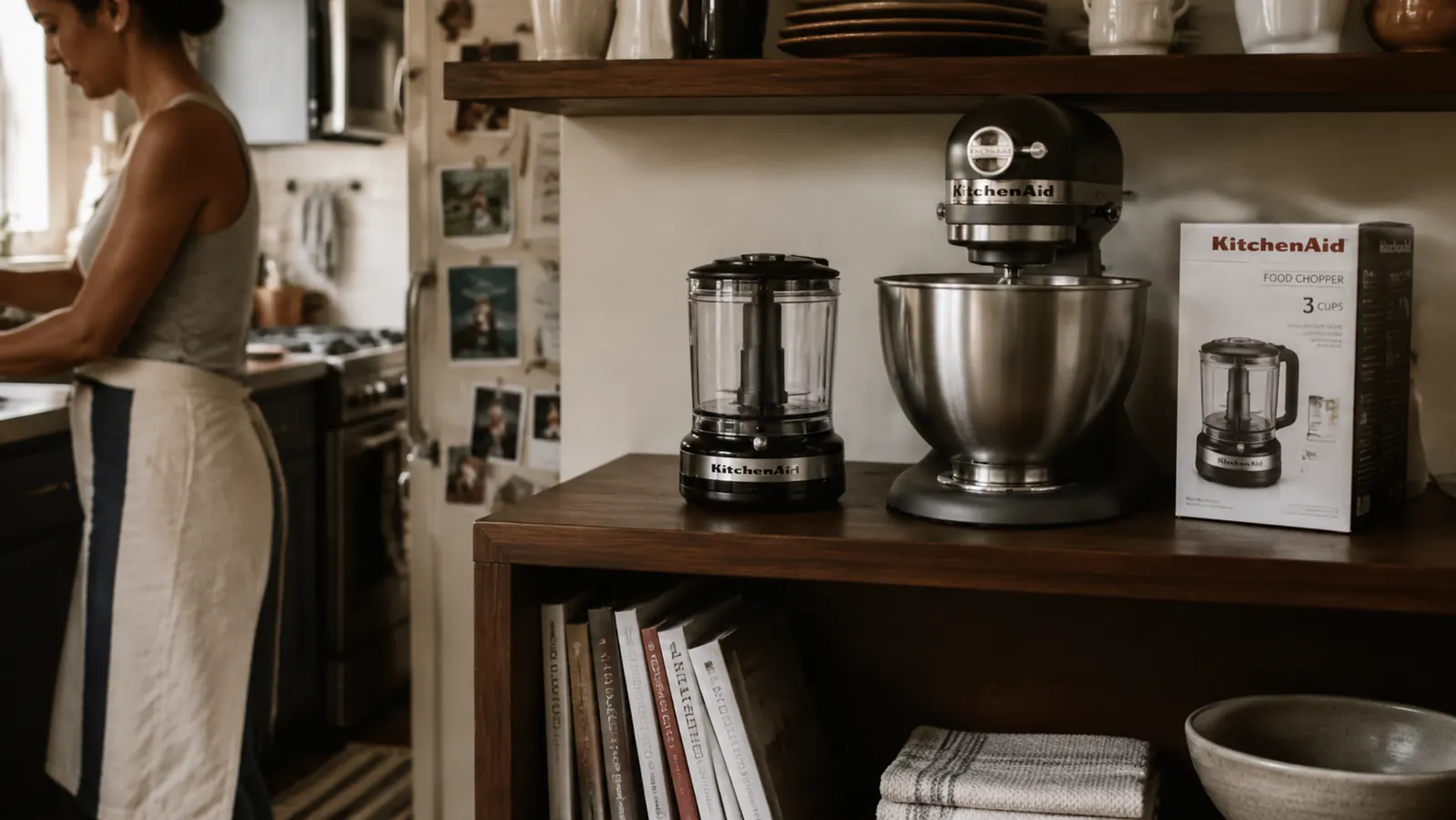
If most of your prep is small jobs, mincing garlic, chopping a single onion, a handful of nuts for a topping, a three-cup mini chopper that lives permanently on the counter will serve you better than the Cuisinart ever will. The whole appeal of a mini chopper is that it skips the setup tax entirely, no closet bin, no step stool, just a small unit you can reach for in the time it takes to grab a knife. I considered one before I bought the Cuisinart, and the only reason I passed was that a three-cup bowl would have meant three separate batches to get through a single pot of soup vegetables, which defeats the purpose for how I actually cook most nights.
Who Should Buy a Stand Mixer Attachment Instead
If you already own a stand mixer and bake more than you cook savory meals, a food processor attachment for that mixer might make more sense than a standalone Cuisinart. You'd be storing one fewer base, since the mixer body is already out or already has its spot, and you'd only be adding the bowl and blade attachment to your storage problem instead of an entire second motor. The tradeoff is that attachments generally can't match a dedicated 600-watt motor on dense chopping jobs, and if savory weeknight prep, not baking, is most of what you'd use it for, a standalone processor like the Cuisinart will outperform an attachment built around a mixer's motor. For a full head-to-head on speed and cleanup, I ran a proper comparison in my other review, but the short version is that a dedicated processor wins on chopping and a mixer attachment wins on kitchen real estate.
Who Should Actually Buy the Cuisinart
The Cuisinart earns its keep if you cook most nights of the week and your prep regularly involves more than one vegetable or a full block of cheese, the kind of volume where the setup tax gets absorbed across enough chopping to be worth it. It's also worth it if you bake a few times a year and want a dough blade that cuts cold butter into flour better than your hands manage, or if you're the kind of cook who batch-preps on Sundays and doesn't mind reloading the bowl once or twice to get through a bigger job. For that kind of week-to-week volume, I found ten specific ways the Cuisinart has actually sped up my prep worth writing down in detail, task by task, rather than as a general claim.
Who Should Skip It
If your prep is mostly small jobs, one onion, a clove of garlic, a handful of herbs, skip it and either use your knife or buy a mini chopper that doesn't ask for a two-hand lift and a trip to the closet every time. If you don't have anywhere to store a base this heavy and seven separate parts, skip it, because a food processor that has to live buried in storage is a different purchase than one that lives permanently on your counter, and my twenty-two inches beside the sink couldn't spare that spot even if I wanted to give it one. And if most of your cooking is for more than four people at once, know going in that the 7-cup bowl will mean reloading, not a single confident pass.
Still worth it, once you know the whole picture
Six months in, and knowing exactly where it earns its keep and where it doesn't, I'd still buy the Cuisinart 7-Cup Pro Classic again. See today's price and current availability on Amazon.
Amazon Check Today's Price on Amazon →